Optijara Multilingual Content Pipeline: From Idea to Reviewed Article
See how Optijara pipelines organize research, writing, images and translation into a checked blogging workflow, with a first-hand look inside ALAGI.

- Content Workflows
- Content pipeline
- Multilingual SEO
- AI content review
- Hreflang
- SEO, AEO and GEO
- Metadata review
Optijara pipelines turn a blogging brief into separate, reviewable stages instead of one long AI prompt. Optijara's AI Content Engine brings together research, writing, images, translation and metadata checks. Here is how that approach works, alongside two real screenshots from our own article-preparation run in ALAGI, Optijara's internal operations cockpit. The screenshots show work in progress, not a completed review or proof of publication.
What a staged content pipeline does
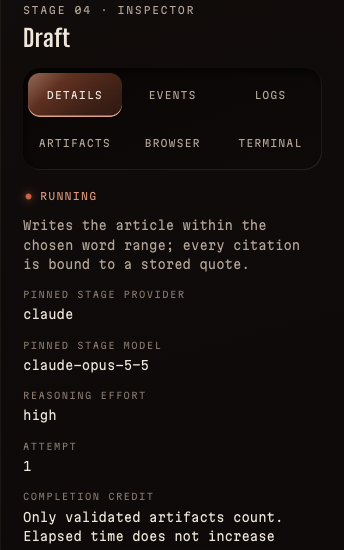
Optijara describes its AI Content Engine as a workflow that researches, writes, creates the image, translates and adds the metadata, with checks between steps before anything moves on.
According to Optijara's service description, the workflow pauses at checkpoints and resumes, so a failed step need not restart the whole article. It also describes opening each live page after publishing to check the text, image, metadata and language versions, with failures fixed before the next run. These are the service's stated capabilities, not guarantees established by our screenshots.
Human review is configurable as well: you can approve every article before it goes live, approve only the monthly topic plan and let articles publish on schedule, or move from one to the other. We'd suggest starting with the stricter option and loosening it only once you trust the output.
SEO, AEO and GEO in plain terms
Whatever labels you use, such as AEO or GEO, Google's position is that optimizing for generative AI search is optimizing for the search experience, and thus still SEO. Its guidance adds that structured data isn't required for generative AI search and there's no special schema.org markup you need to add. Nor does using AI give content any special gains, in Google's view, because it's just content.
A step-by-step workflow from idea to reviewed article
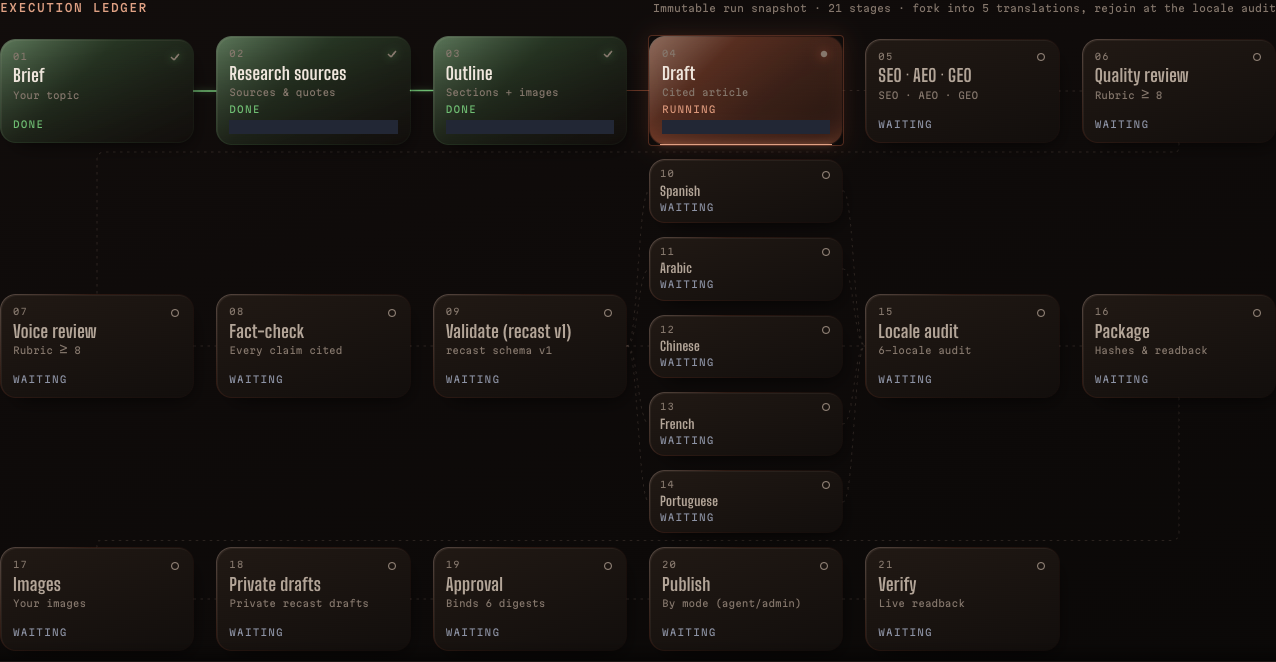
The following Optijara pipeline example assumes article-by-article human approval. It is modelled on our ALAGI preparation workflow and describes a recommended review path, not a record of the checks this article received or a mandatory sequence for every service customer.
- Brief: set the topic, audience and notes, including which claims need sources.
- Research: collect sources and exact quotes so every claim can point somewhere.
- Outline: plan sections and assign quotes to each before writing prose.
- Draft: write from the outline, then run the review checklist below.
- Image, translation and metadata: check each one separately.
- Image: the alt text matches the picture.
- Translation: a fluent reader reviews it, and its hreflang set is complete.
- Metadata: the title and description match the body.
- Human approval: a person signs off before anything goes live.
- Live-page check: after publishing, open each live page and fix anything that fails before the next run.
Reviewing the draft and the metadata, not just the text
Generative models don't retrieve facts; they predict a likely sequence of words, as Google explains. That is why Google calls it critical to manually fact-check and review all AI-generated content before publishing. The review covers title elements, meta descriptions, structured data and image alt text too, since these can appear in Search results.
According to Search Engine Journal, Google added a warning that AI output may contain errors, plus advice to fact-check it by hand. SEJ's takeaway is that a process built only for article copy misses part of what the guidance now covers. One more question comes from Google's helpful content guidance: whether you give readers background on how automation or AI was used to create content.
A practical review checklist:
- Every factual claim points to a specific source quote.
- Every number matches its source exactly.
- Title and meta description match what the article says.
- Structured data matches the visible page content.
- Image alt text describes the real image.
- Readers get background on how any automation or AI was used.
- Each language version is read by someone fluent in it.
Going multilingual without creating duplicates
Once one version passes that checklist, each translation needs the same care. Optijara describes adapting its Arabic for Gulf readers and laying it out right to left, rather than translating word for word. That matters for readers and for search: localized versions count as duplicates only if the main content of the page remains untranslated, according to Google.
Optijara's public AI Content Engine offering describes English and Arabic articles. The six language versions of this ReShare article do not establish that six languages are included in that offering.
For multilingual pages, keep each hreflang set complete and self-referencing. W3C also recommends declaring the page language with lang and using dir for bidirectional text such as Arabic.
For a working example, Optijara points to AI Resum, which publishes AI news summaries in 6 languages, including Arabic, with every source linked. This is an example of source-linked multilingual publishing, not a claim that this article was published or syndicated through AI Resum.
Common mistakes and caveats
- Volume without value. Using generative AI to create many pages without adding value for users may violate Google's scaled content abuse policy.
- No human in the loop. Large amounts of AI text produced without manual oversight or curation count as little to no effort in Google's quality guidance.
- Treating markup as a shortcut. No special markup is needed for generative AI search, Google says, so add structured data to describe the page accurately rather than to win a place in AI answers.
Key takeaways
- Optijara pipelines separate research, writing, images, translation and metadata into reviewable work; Optijara describes checkpoint resumption and live-page checks.
- Google treats optimizing for generative AI search as SEO and requires no special schema markup for it.
- Fact-check AI content by hand, including titles, meta descriptions, structured data and image alt text.
- Fully translated versions are not duplicates; use complete self-referencing hreflang sets, a lang attribute and dir for Arabic.
- Choose the human review level deliberately: Optijara describes approval per article or at monthly topic-plan level. In this example, keep article-by-article sign-off and check each live page after publication.
Conclusion
Optijara pipelines make a blogging workflow easier to follow by separating the work into reviewable stages. Staged checks only help if they cover everything a reader and a search engine see. Check metadata as carefully as copy, and treat each language as its own article. Then pick one upcoming article and run the review checklist above on it before it goes live, covering its metadata and every language version.
Frequently asked questions
What are Optijara pipelines, and is that the service name?
Here, Optijara pipelines describes the staged blogging workflow. The public service is called AI Content Engine. Its description includes research, writing, images, translation and metadata checks, with approval available per article or at monthly topic-plan level.
What should a fluent reviewer check in a translated version?
Check that it reads naturally for its intended audience rather than as a word-for-word translation, that facts and numbers still match the sources, and that the title, meta description and alt text were translated along with the body.
Our current review only covers article copy. Where should we start?
Add the metadata first: title, meta description, structured data and image alt text, since Google's fact-check guidance covers these too. Once that is routine, add a check of each live page after publishing.
Is structured data still worth adding if AI search does not need it?
It can still support general SEO, so keep it where it accurately matches the visible page. Just do not add it expecting a place in AI answers, because Google says no special markup is needed for generative AI search.
Sources
- https://www.optijara.ai/en
- https://www.optijara.ai/en/services/ai-content-engine
- https://airesum.com/en
- https://developers.google.com/search/docs/fundamentals/using-gen-ai-content
- https://developers.google.com/search/docs/fundamentals/ai-optimization-guide
- https://developers.google.com/search/blog/2026/05/a-new-resource-for-optimizing
- https://developers.google.com/search/docs/fundamentals/creating-helpful-content
- https://developers.google.com/search/docs/specialty/international/localized-versions
- https://www.w3.org/International/questions/qa-html-language-declarations
- https://www.searchenginejournal.com/google-fact-check-ai-content-before-publishing/591782/
- https://developers.google.com/search/blog/2023/02/google-search-and-ai-content
- https://developers.google.com/search/docs/appearance/structured-data/intro-structured-data